

Bioko Gastronomy: What to Eat and Which Dishes to Know
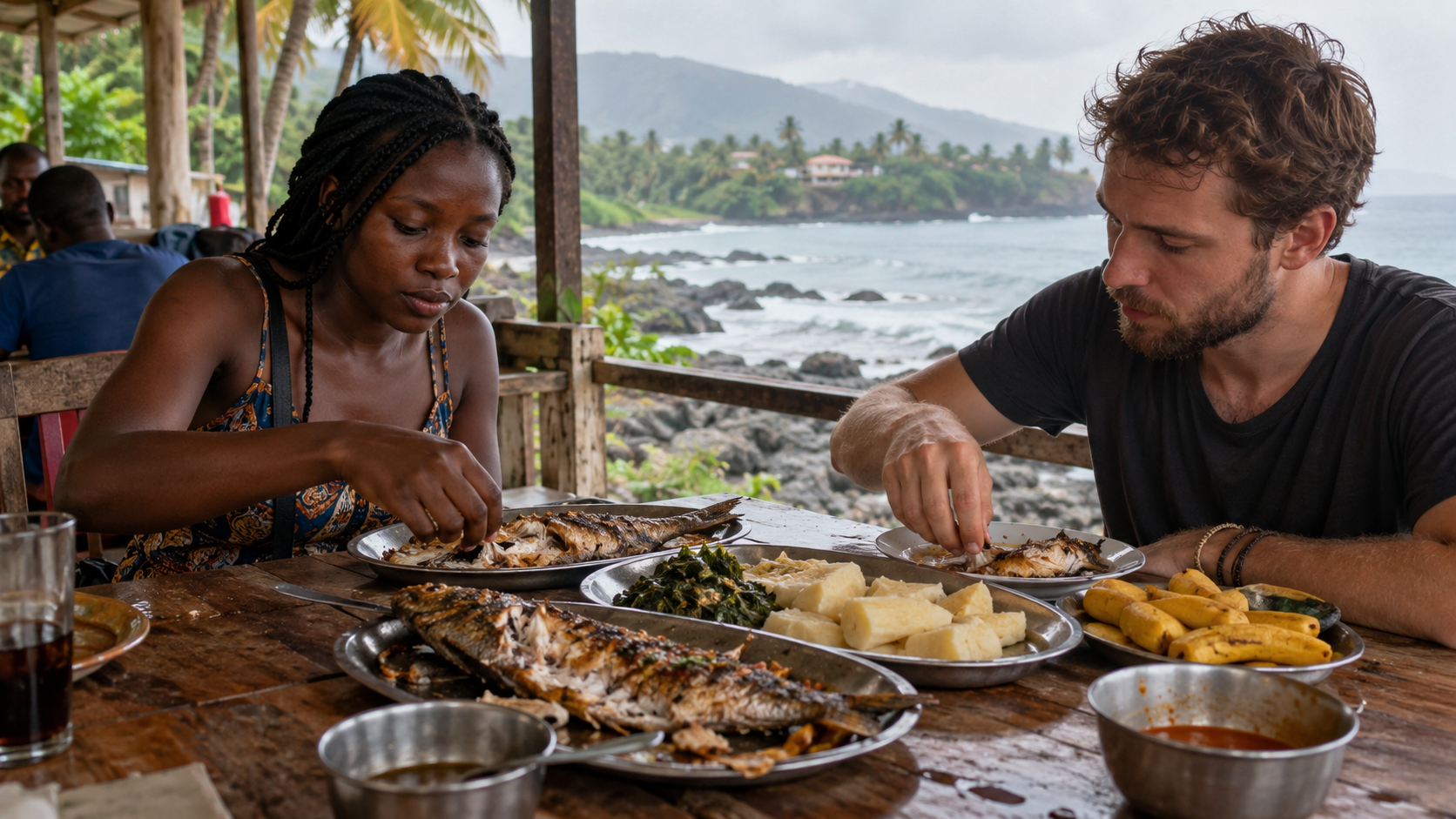
Bioko gastronomy combines fish and seafood with plantain, cassava, malanga, yam, palm products, sauces and spiced preparations. Bubi culinary tradition has a place of its own, although the food found in Malabo today also reflects recipes and influences from other communities in Equatorial Guinea and the wider West African region. Cocoa adds another layer to this identity because of its close connection with the island’s agricultural history.
It is worth keeping this in mind before talking about typical dishes. Bioko is a tropical island surrounded by the Atlantic, but its cuisine cannot be explained simply by saying that people eat fish, tubers and tropical produce. What is grown, how food is preserved, who has lived on the island and the cultural exchanges that have taken place over time all matter.
Not everything eaten in Malabo today originated on Bioko, either, and not every Equatorial Guinean recipe belongs to Bubi tradition. The difference may seem minor when all you want to do is decide what to order, but it prevents almost any popular national dish from being labelled as a traditional dish of the island.
| Element | What Characterises the Cuisine |
|---|---|
| Fish and coastal cooking | Fresh and smoked fish, soups and different cooking methods |
| Staples and accompaniments | Plantain, cassava, malanga and yam |
| Flavours | Palm products, groundnuts, sauces, spices and chilli |
| Cultural tradition | Bubi roots alongside other traditions found in Malabo |
| Product closely linked to Bioko | Cocoa |
| Starting point for travellers | Malabo |
What Is Bioko Gastronomy Like?
A handful of ingredients appear repeatedly and explain much of the island’s cooking. Fish, tubers and plantain are among the most recognisable. Around them you find sauces, leafy vegetables, palm oil and seasonings that can alter the character of a dish considerably.
Cassava, malanga and yam may be boiled, served alongside other foods or used in more elaborate preparations. Plantain plays a similar role, although its flavour and texture depend heavily on how it is cooked. It is misleading to think of these foods simply as side dishes in the European sense. In many meals, they are an essential part of the dish itself.
Fish is equally varied. It may be served fresh, smoked, cooked in soup or accompanied by a stronger sauce. Chilli appears in certain preparations, but that does not mean all food on Bioko is hot or that recipes are always seasoned to the same level.
Then there is Malabo itself. The capital brings different traditions together, so a recipe can be common in the city without being specifically Bubi or originating on Bioko. Asking what a dish contains and where it comes from often tells you more than any fixed list of “typical foods”.
The Ingredients That Explain Bioko Cuisine
If it is your first visit to the island, recognising a few common ingredients will be more useful than trying to memorise the names of dozens of dishes. Once they become familiar, it is easier to understand why apparently different preparations often share similar flavours and textures.
Fish and Seafood
Fish appears in many forms on Bioko. It can be served fresh, grilled, cooked in a stew or used as the basis of a soup. Smoked fish is also eaten, producing a very different flavour and texture.
Pepesup is a good example of how culinary influences overlap. It is a seasoned soup, often spicy, that can be prepared with fish. It is commonly eaten in Equatorial Guinea, but its tradition extends beyond Bioko and is related to other pepper soups found across West Africa.
That distinction matters. A dish can be common in Malabo without having originated on the island. It can still be part of the contemporary gastronomic experience while belonging to a much broader regional tradition.
Plantain, Cassava, Malanga and Yam
Plantain, cassava, malanga and yam frequently appear alongside fish, meat, sauces or stews. Each has a different texture and reacts differently to cooking.
Malanga may be eaten boiled or used in dough-like preparations. Cassava can be prepared in several ways, while plantain changes considerably depending on whether it is boiled, fried or cooked by another method. Yam, meanwhile, has a historical connection with traditional Bubi food.
Calling all of them simply “side dishes” does not really describe their role. In many meals, they are the part that gives the dish its substance and helps bind the different flavours together.
Palm Products, Groundnuts and Stronger Flavours
Palm-derived products appear in a number of traditional preparations. Recipes may also include groundnuts, leafy vegetables and chilli.
This is why Bioko cuisine is poorly represented when reduced to simply cooked fish and tropical fruit. Soups, dough-like preparations, thick sauces, cooked leaves, tubers and much stronger flavours are also part of the wider culinary repertoire.
Dishes and Preparations Worth Knowing
There is no single list of dishes that can all be labelled, without qualification, as “typical of Bioko”. Some recipes have a direct connection with the island. Others have long been eaten there but also belong to the cuisine of other parts of Equatorial Guinea or the surrounding region.
That distinction makes it more useful to focus on what each preparation tells you rather than on how many dishes you can name.
Bocaó or Bocahó
Bocaó or bocahó is one of the preparations most clearly associated with Bioko. It is a broth made with leaves that may include fish and palm oil and can be served with malanga, plantain or similar foods.
Traditional recipes are rarely completely standardised. The spelling of the name, ingredients and details of the preparation may change between families or locations. Searching for one definitive version of a dish like this can oversimplify a cuisine that has often been passed down within households.
Pepesup
Pepesup belongs to a different context. It is a seasoned soup widely known in Equatorial Guinea and related to other West African pepper soups.
When made with fish, it can be a good introduction to stronger flavours than those found in simply prepared grilled or cooked fish. Broth, spices and chilli are much more prominent here.
It does not need to be presented as exclusive to Bioko to be relevant. Its wide distribution actually says something useful about the culinary links that run through the region.
Abalá
Abalá appears among the traditional preparations of Equatorial Guinean cuisine. It may be made from a dough-like mixture and cooked wrapped in leaves, with the ingredients varying according to the recipe.
For travellers used to a different style of cooking, the technique may be almost as interesting as the flavour. The leaves used for wrapping, the cooking method and the texture of the mixture all form part of the preparation and make it quite different from a conventionally plated dish.
Bitalif and Other Leaf-Based Preparations
Bitter leaves also appear in a variety of regional recipes. Bitalif is associated with this style of cooking and may combine leafy vegetables with fish, meat and other ingredients.
Related dishes exist in neighbouring countries, including Cameroonian ndolé, but the two names should not automatically be treated as referring to exactly the same recipe. Ingredients and techniques vary by location, and terminology is not always identical either.
Fish with Local Accompaniments
You do not need to seek out the most unusual dish on the menu to begin understanding Bioko cuisine. Fish served with plantain, cassava or malanga already brings together several of its basic elements.
For someone tasting these ingredients for the first time, that simplicity can even be an advantage. You recognise the textures and flavours first. More strongly seasoned soups and complex sauces make more sense afterwards.
| Preparation | What It Helps Explain | Useful Distinction |
|---|---|---|
| Bocaó or bocahó | Cuisine directly associated with Bioko | Recipes may vary |
| Pepesup | Soup, fish, seasoning and chilli | Not exclusive to Bioko |
| Abalá | Doughs, leaves and traditional cooking techniques | Its culinary context extends beyond the island |
| Bitalif | Culinary use of leaves and other ingredients | Related regional preparations exist |
| Fish with plantain or tubers | Connection between the sea and agricultural products | Not one single fixed recipe |
Bubi Gastronomy: Bioko’s Own Culinary Tradition
The gastronomic history of Bioko cannot be understood without the Bubi people. Their relationship with agriculture, available crops and the island’s natural resources lies behind many longstanding food traditions.
Tubers such as yam and various palm products have formed part of that relationship between food and landscape. These ingredients were not chosen because they were considered “typical”, in the way a modern travel guide might classify them. People cooked with what the land offered and with techniques passed down through their communities.
Malabo is far more mixed today. The capital brings together people and traditions from different parts of Equatorial Guinea, alongside influences from other countries in the region. Treating local food and Bubi food as interchangeable therefore leads to mistakes quite quickly.
When a dish is described as typical of Bioko, it is worth asking one simple question: is it specifically Bubi, an Equatorial Guinean recipe widely eaten on the island, or a regional dish incorporated into everyday cooking in Malabo?
Sometimes there will be no perfectly clear-cut answer. Traditional food rarely fits into cultural boundaries as neatly as tourism lists suggest.
Fish and the Sea: How Bioko’s Geography Shapes Its Cuisine
Fish is so prominent for an obvious reason. Bioko is an island, and the coast has influenced the food of many communities for generations. But the relationship with the sea varies depending on location, availability and the way fish is preserved.
Luba, on the island’s western coast, helps make that connection tangible. Coastal activity is part of the everyday landscape there, and fish naturally occupies an important place in local food. What is interesting is not necessarily finding one emblematic recipe, but seeing how fish is combined with agricultural foods such as plantain, cassava or malanga.
That is also why searching for a single “typical Bioko fish dish” does not tell you very much. The cuisine often works through combinations of product, accompaniment and cooking technique.
If you want to leave the capital during your stay and see other parts of the island, this guide to excursions around Bioko Island covers different options for organising trips from Malabo.
Bioko Cocoa: Product, History and Territory
Cocoa occupies a different place from most other foods. Its importance on Bioko comes less from being part of an everyday recipe and more from the role it has played in the island’s agricultural history.
During the colonial period, cocoa cultivation became economically significant and left its mark on particular parts of Bioko. It is therefore worth avoiding an overly picturesque view of the old plantations. Cocoa is tied to a complex economic and social history, not simply to an attractive tropical crop for visitors.
In the south of the island, places such as Batete are still closely associated with this agricultural past. Elements of the landscape connected with cocoa production can still be recognised there.
For travellers interested in food, that connection changes the way the product is understood. Cocoa provides an entry point into part of Bioko’s history, its agriculture and the economic changes the island experienced.
The subject deserves a separate, deeper treatment. Here its role is more focused: to explain why it is difficult to talk about Bioko’s products without mentioning cocoa.
What to Eat in Malabo to Get to Know Bioko Gastronomy
Malabo is a good place to start, but expectations need to be realistic. The capital brings together Equatorial Guinean cuisine, dishes from different communities and international food. Sitting down in a restaurant in Malabo does not automatically mean the meal will be specifically Bubi.
A practical way to orient yourself is to look first at the ingredients. Fish, plantain, cassava, malanga, yam, palm products and local sauces are useful clues. Then ask how the dish is prepared and where the recipe comes from.
One particularly useful question concerns the level of chilli. Some preparations are mild and others much more heavily seasoned, so asking before ordering avoids unnecessary surprises.
If You Prefer to Start with Milder Flavours
Simply prepared fish with plantain or a tuber allows the ingredients themselves to remain clear. It is a sensible introduction before moving on to more heavily seasoned soups or sauces.
If You Want Stronger Flavours
Seasoned soups and dishes served with sauces offer a noticeably different profile. This is where asking about the level of chilli becomes worthwhile, because intensity can vary considerably.
If You Are Interested in Tradition
Ask where the dish comes from. “Local”, “Equatorial Guinean” and “Bubi” are not synonyms, even if they are sometimes used rather loosely on menus or in casual conversation.
If You Are Interested in Bioko’s History
Cocoa is one of the products that most clearly connects food, agriculture, territory and the island’s economic history.
Malabo as a Base for Discovering Bioko
Food makes more sense once you leave the capital and see some of the landscapes behind it. Bioko changes considerably between the coast, the interior, volcanic areas and places historically connected with particular crops.
That does not mean you need to travel around the whole island to eat well. It means that knowing where certain products come from, and seeing how the landscape changes, can alter the way you understand the food you later encounter in Malabo.
If you only have a few days, these visits can be fitted into a wider itinerary using our guide to what to do in Malabo in 3 days.
Journeys outside the city also benefit from some advance planning. Our tips for getting around Malabo, the airport and Bioko explain how to prepare those trips more carefully.
If you are staying at Hotel Anda Malabo, the capital can serve as a base for combining time in the city with journeys to other parts of Bioko, adapting them to the time available and the conditions of each trip.
You can continue planning your stay with our Malabo and Bioko travel guides.
Frequently Asked Questions About Bioko Gastronomy
What do people eat on Bioko?
Fish, plantain and tubers such as cassava, malanga and yam are common on Bioko. Palm products, sauces and seasoned preparations also appear frequently. Alongside this base are recipes from Bubi tradition and others shared with different communities in Equatorial Guinea and West Africa.
What are the typical dishes of Bioko?
It is worth distinguishing between dishes directly associated with the island and those that are simply eaten there frequently. Bocaó or bocahó has a particularly clear connection with Bioko. Other preparations, such as pepesup, belong to a broader regional culinary tradition.
Which dish is particularly associated with Bioko?
Bocaó or bocahó is one of the preparations most directly associated with the island. It is a broth made with leaves that may include fish and palm oil and can be served with malanga, plantain or similar foods.
Is Bioko food spicy?
Some soups, stews and sauces can be quite heavily seasoned, but the intensity varies according to the recipe and the person preparing it. If you are not accustomed to chilli, the most practical option is to ask before ordering.
What is the connection between Bioko and cocoa?
Cocoa played a considerable role in Bioko’s agricultural and economic history and left a visible mark on some parts of the island. Places in the south, such as Batete, remain particularly associated with this productive past.
What can you eat in Malabo?
Malabo brings together Equatorial Guinean food and dishes from other culinary traditions. To get closer to local cuisine, look for preparations using fish, plantain, cassava, malanga, yam, palm products and traditional sauces. If you specifically want to try Bubi food, ask about the origin of the recipe.
Is all Equatorial Guinean food typical of Bioko?
No. Equatorial Guinea contains different culinary traditions, and many dishes have spread between communities and territories. The fact that a recipe is eaten in Malabo today does not mean it originated on Bioko or belongs specifically to Bubi tradition.
