

Sunsets in Malabo: how to choose a location and organise your outing
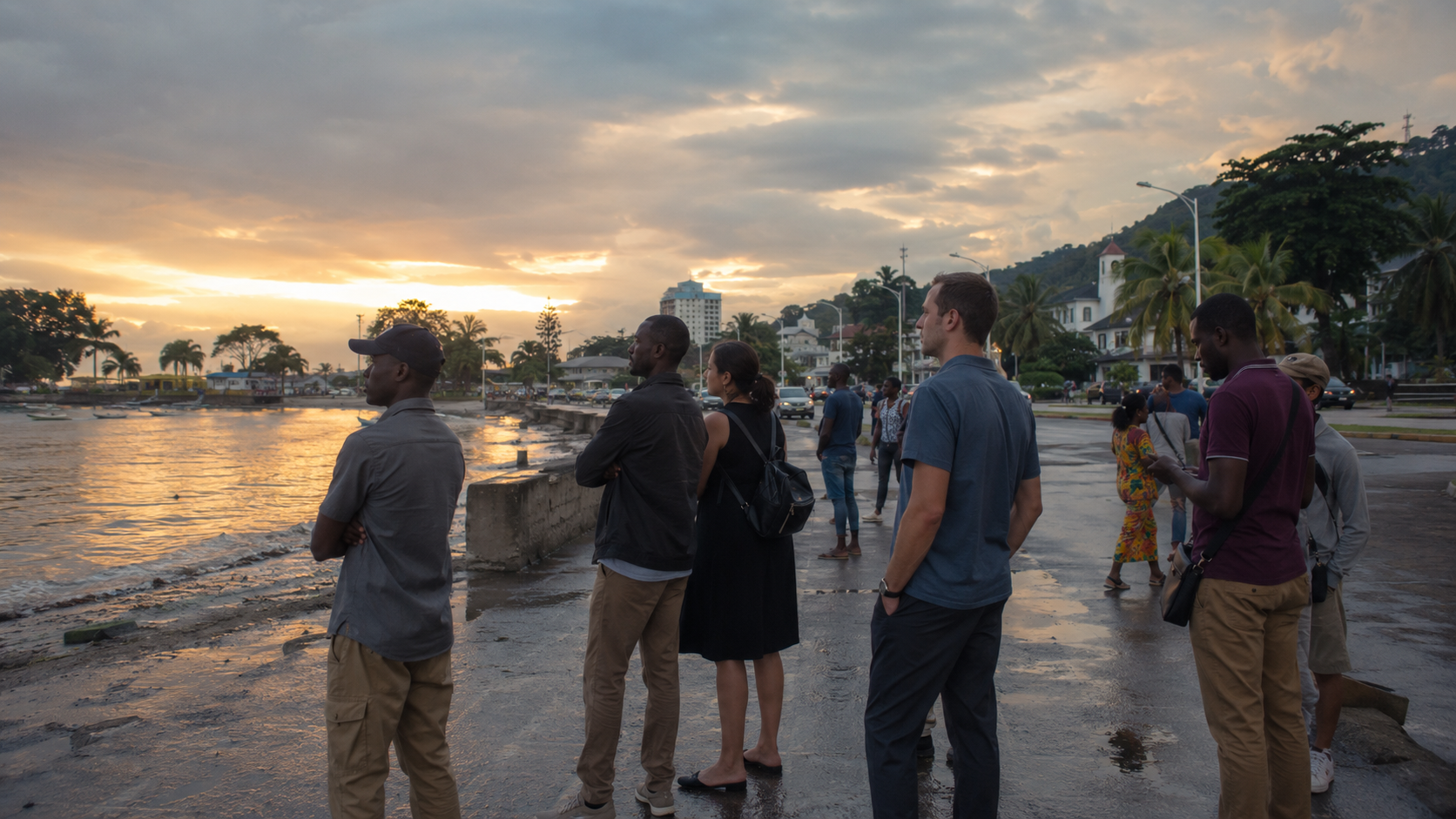
Watching the sunset in Malabo is not simply a matter of heading towards the sea and waiting. The orientation of the location, buildings, vegetation and, above all, cloud cover can hide the sun before it reaches the horizon. Even so, the late afternoon can produce particularly attractive light over the city or the water.
Check the exact sunset time, arrive early and arrange your return before setting out. These are three simple decisions, but they make a considerable difference when the sky changes quickly or the chosen location lies outside the urban area.
Sunsets in Malabo do not always resemble the classic image of an unobstructed sun sinking into the sea. Sometimes the most interesting elements are the reflections, illuminated clouds or the remaining light over the city skyline. It is best to organise the outing with this in mind.
Quick answer: choose an urban or waterfront location with a sufficiently open view, check the sunset time for the exact date and arrive before the stated time. If you plan to travel outside Malabo, arrange both the outward and return journeys in advance. There may still be enough daylight for a walk even when a bank of low cloud completely hides the sun.
What to realistically expect at the end of the day
Malabo is located on Bioko Island, in the Gulf of Guinea and close to the equator. Day length varies less throughout the year than it does in Spain and other places at higher latitudes. This does not mean that sunset occurs at exactly the same time every day. You still need to check the time for the specific date of your visit.
The astronomical sunset time indicates when the sun disappears below the horizon, but the experience at street level can be quite different. A building, dense vegetation, the terrain or a bank of low cloud may hide it earlier. Humidity can also reduce the clarity of the horizon, even on an afternoon without rain.
Clouds do not necessarily ruin the plan. When they are scattered, they can catch the light and add depth to the sky. A thick, uniform layer leaves less room for variation: the sun remains hidden and the transition in light is usually more subdued.
There is another important distinction to understand. Being beside the sea does not necessarily mean watching the sun set over the water. A coastal location may offer open views, reflections and an appealing late-afternoon atmosphere without directly facing the point where the sun disappears.
How to choose where to watch the sunset in Malabo
The view matters, but it is not the only consideration. An open and secluded location may initially seem like the most attractive choice, until travel time, weather conditions and the journey back after dark are taken into account. For a short evening outing, a carefully chosen urban location is often the more sensible option.
The possibilities can be grouped into three settings: urban areas, locations close to the waterfront and places elsewhere on Bioko that require an organised excursion. Each involves a different type of plan.
| Type of location | What you may find | Best suited to | What to check |
|---|---|---|---|
| Urban area | Evening light over the city and late-afternoon activity | Travellers with limited time or a busy schedule | Obstacles, traffic and return arrangements |
| Waterfront | Reflections, open space and broader views | Relaxed walks and photography | Orientation, access and the chosen section |
| Location outside Malabo | Bioko landscapes and a less urban setting | Excursions planned in advance | Travel time, transport and the return journey |
There is no single answer that works for everyone. If you only have an hour, spending a large part of it travelling will usually make the experience less enjoyable. If the sunset is part of an excursion that has already been arranged, adjusting the itinerary to make use of the final light may make sense.
An urban location when time is limited
A location within the city works well after a meeting, before dinner or during a stay with only a few free hours. It reduces travel time and makes it easier to change plans if it begins to rain or the sky becomes completely overcast.
The compromise is the presence of obstacles. Buildings and trees may hide the sun well before the astronomical sunset time. This does not make the walk a poor choice. The light falling across the streets, architecture and vegetation may prove more interesting than a completely unobstructed horizon.
For a short outing, prioritise an easy return. If the intention is to end the day at a relaxed pace, a nearby walk followed by a stay at a quiet hotel in Malabo makes more sense than an improvised excursion late in the day.
A location close to the waterfront
The waterfront is appealing because of its open character and the reflections across the water, but the view changes from one section to another. Orientation is not identical at every point, and buildings, vegetation or other features may also affect the view.
If you want to see the sun itself, knowing that you will be beside the sea is not enough. You need to find a section with a suitable view of the horizon. If your aim is simply to enjoy the light and take a walk, you can be more flexible. Even when the sun remains hidden, the clouds and reflections may still make the outing worthwhile.
If you plan to take photographs, arrive early. This will give you time to find an open composition without obstructing entrances, pavements or pedestrian areas. You will also be able to change position if a bank of cloud covers the exact part of the horizon you intended to photograph.
Outside the urban area
The surroundings of Malabo and other parts of Bioko require a different approach. They should not be treated as an automatic extension of a city walk or as an alternative to decide upon when the sun is already beginning to set.
In this case, the sunset needs to be integrated into the complete itinerary. The journey, access and return arrangements must all be planned before departure. You should also have a reasonable alternative in case the weather deteriorates or visibility becomes poor.
Travelling towards an unfamiliar area shortly before nightfall adds difficulty without necessarily improving the experience. If the visit forms part of an organised excursion, adjusting a scheduled stop to coincide with the final daylight can be worthwhile.
What time does the sun set in Malabo?
Malabo’s proximity to the equator means that sunset time varies less throughout the year than it does in Spain. However, there is no single time that applies to every date. Check the updated sunset time for the specific day of your outing.
Do not arrive at the stated time. That reference indicates when the sun disappears below the astronomical horizon, not necessarily when you will stop seeing it from your location. Clouds, buildings, vegetation and the terrain may hide it considerably earlier.
Arriving in advance gives you time to assess the orientation, identify obstacles and move to another position if the horizon is covered. If you are travelling by vehicle, allow extra time for possible delays along the way.
Preparation can be reduced to three decisions:
Time: check sunset for the exact date and arrive early.
Sky: review cloud cover, rain and visibility a few hours before setting out.
Return: decide how you will get back, particularly if you leave the urban area.
Some daylight remains after sunset, but this should not be used as a reason to postpone a return journey that has not been properly arranged.
Clouds, rain and humidity: when to keep the plan
A weather forecast provides guidance, but it cannot describe exactly how the sky will behave along the horizon. An afternoon forecast to have sunny intervals may still end with a bank of low cloud precisely in the direction of sunset. The opposite can also happen: a changeable forecast may produce breaks in the cloud and more attractive light than expected.
Check how conditions are developing a few hours before leaving. The most useful factors are the probability of rain, the amount of cloud and visibility. A general sun or cloud icon reveals very little about what you will encounter at the end of the day.
With scattered clouds, the outing can still be worthwhile. They may introduce colour, contrast and depth that a completely clear sky cannot provide. A uniform cloud layer reduces the likelihood of seeing the sun, although the walk may still make sense as part of a broader plan.
If heavy rain or poor visibility is expected, choose a nearby location or change your plans. A long journey is difficult to justify when the entire outing depends on a very narrow window of favourable weather.
Humidity also affects photography. A camera or phone lens can mist over without the problem being immediately obvious. Carrying a clean cloth and simple rain protection can prevent many of these issues.
No particular month guarantees a clear sunset. Drier periods may offer more opportunities for breaks in the cloud, but the conditions on that specific afternoon matter more than any general seasonal recommendation.
Arrange transport and the return journey in advance
Choosing the location tends to receive most of the attention. The return journey is often left until later, precisely when there is less light and less room to deal with unexpected problems.
A nearby urban area may only require a short journey. Outside the usual routes, the situation changes. Distance, road conditions and sudden rain can make the return more difficult than the outward journey.
Before leaving, define your destination and how you will reach it. If you are using a vehicle, agree on the collection point and time. Having a working phone also makes it easier to communicate a change if the weather deteriorates or you decide to return early.
Do not assume that a route is suitable for walking merely because the distance appears short on a map. Lighting, traffic, rain and the actual condition of the route matter more than the number of kilometres.
Business travellers can incorporate the sunset into a broader day without turning it into an excursion. If the trip also includes meetings or professional gatherings, this guide to organising a corporate event in Malabo covers other practical aspects worth preparing before the stay.
Which option fits your evening?
The right location depends on how much time you have, the type of view you want and the effort required to reach it.
| Your situation | Most sensible option | Main priority |
|---|---|---|
| You only have one hour | Nearby urban area | Arriving and returning without complications |
| You want a sea view | Open section close to the water | Orientation and an unobstructed horizon |
| You want to take photographs | A location you can reach early | Composition, humidity and changing cloud cover |
| You have just finished a meeting | Short outing within the urban area | Avoiding unnecessary journeys |
| Rain is possible | Location that is easy to leave | Quick return |
| You already have an organised excursion | Stop incorporated into the route | Schedule and transport |
For a sea view, check the orientation and do not assume the sun will appear directly over the water. The walk may still be worthwhile for the reflections and atmosphere, but the scene could differ from the one you imagined.
If you want to take photographs, arriving early matters more than carrying sophisticated equipment. A simple camera or phone can capture the scene effectively when the lens is clean, the composition has sufficient space and the exposure is adjusted for the sky.
After a meeting, a short outing is usually the most practical choice. The end of a professional day is not the ideal time to attempt an unfamiliar route outside Malabo.
Taking photographs without turning the location into a set
Photography should adapt to the surroundings. Do not block pavements, entrances or areas of pedestrian traffic to obtain a particular composition. Do not enter restricted areas or ignore instructions displayed at the location.
If other people are clearly recognisable and become the main subject of the photograph, ask for their permission before taking the picture.
Humidity may mist the lens and leave the scene looking flat or lacking in contrast. Check the glass before starting and protect your equipment if rain is likely. This simple precaution prevents you from discovering the problem after the evening has ended.
The sun does not need to appear in every photograph. Reflections on the water, illuminated clouds, urban silhouettes and changing light over the vegetation can also convey the atmosphere at the end of the day in Malabo.
If the weather does not cooperate
An overcast afternoon does not always require cancellation. If it is not raining, you can still take a short walk and watch the light change over the city. There may be no visible sunset, but the outing can remain worthwhile if it was not entirely dependent on that one image.
With heavy rain or severely reduced visibility, it is better to shorten the plan. If you are staying in Malabo for several days, there may be another opportunity to check the forecast and try again.
You can also include the sunset within another activity. That way, if the clouds hide the sun, the walk or visit will not have been wasted.
On some afternoons, persisting merely adds an uncomfortable journey. Choosing a nearby alternative or returning earlier is a reasonable decision, not a missed opportunity.
Frequently asked questions about sunsets in Malabo
Where can you watch the sunset in Malabo?
Urban areas with open views and some locations close to the waterfront can offer good conditions for experiencing the late-afternoon light. Whether the sun itself is visible will depend on orientation, buildings, vegetation and cloud cover. For any location outside Malabo, arrange both outward and return transport in advance.
What time does the sun set in Malabo?
The time depends on the date, although annual variation is smaller than in Spain because Malabo is close to the equator. Check the time for the specific day and arrive early. Terrain, obstacles and clouds may cause the sun to disappear from view beforehand.
Can you see the sunset from Malabo’s waterfront?
It depends on the section, its orientation and the state of the sky. The surroundings may offer reflections and attractive light over the water, but this does not mean that the sun itself will be visible over the maritime horizon. It is best to choose the exact location beforehand.
How early should you arrive?
Allow enough time to find an open view, assess the horizon and change position if you encounter obstacles. The required margin will depend on the journey and the type of photographs you want to take. If you are using a vehicle, allow for possible delays as well.
What is the best time of year to watch sunsets in Malabo?
Periods with less rainfall may provide more opportunities for breaks in the cloud, but no time of year guarantees a clear sky. The forecast for that particular afternoon, especially cloud cover, rain and visibility, is more useful than the month of travel alone.
Is it worth going out if the sky is cloudy?
Yes, when there are scattered clouds and heavy rain is not expected. Clouds can catch the colour and add depth to the scene. If the cover is uniform, the sun will probably remain hidden. In that situation, treat the outing as a walk rather than a visit devoted exclusively to the sunset.
Do you need transport?
It depends on the location and where you are staying. Transport may not be necessary for a nearby urban location. If you are leaving the usual area, arrange both the outward and return journeys before setting off.
What should you check before leaving?
Check the sunset time, review the development of cloud cover and rain, confirm that the location is accessible and decide how you will return. If you are travelling by vehicle, agree on the collection time and meeting point.
Can you photograph the sunset with a phone?
Yes. Clean the lens, avoid excessive digital zoom and adjust the exposure using the sky as your reference. In a humid environment, protect the device from rain and check that the lens has not misted over.
A well-planned evening does not depend on a perfect sky
Enjoying sunsets in Malabo depends partly on the weather, but also on several practical decisions: checking the time, reviewing the forecast, choosing a location that suits the time available and arranging the return journey.
The sun will not always appear over a perfectly clear horizon. On some evenings, the most interesting elements will be the clouds, reflections or the remaining light over the city. A flexible plan allows you to enjoy the moment without chasing an image that the sky may not provide.
