

Culture of Equatorial Guinea: Peoples, Traditions and How to Experience It from Malabo
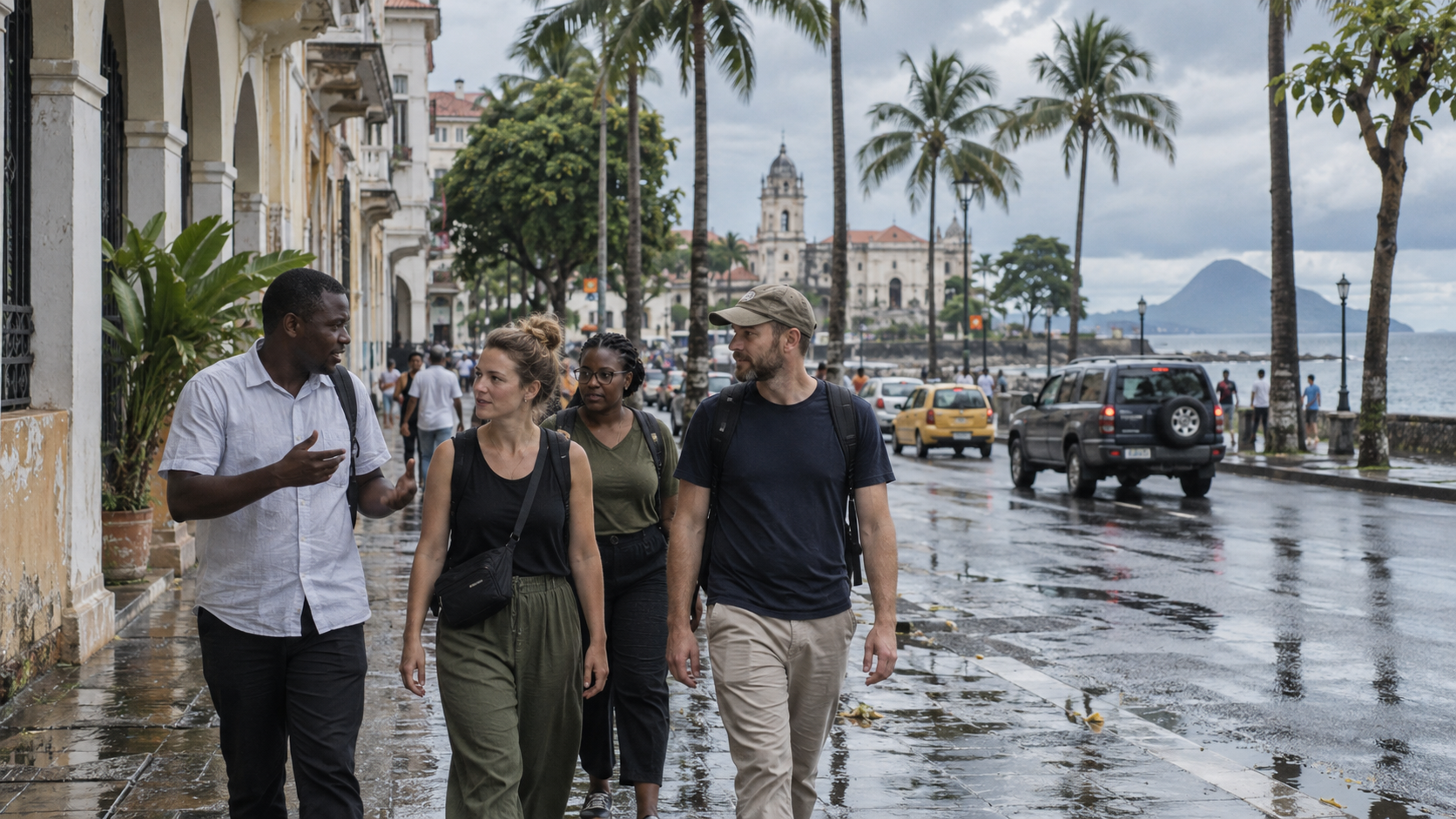
The culture of Equatorial Guinea is diverse. Within the same country, the traditions of peoples such as the Fang, Bubi, Ndowe, Annobonese and Bisio coexist alongside several languages and a history in which African roots meet European influence, particularly Spanish. That diversity can be seen in music, food, celebrations, everyday life and in the cultural differences between Bioko, the mainland region and Annobón.
For anyone arriving in Malabo, this distinction changes the way the destination is understood. The city is located on Bioko and offers an introduction to a very specific part of Equatoguinean life. Not all of it. Treating what you see in Malabo as a summary of the entire country would be as inaccurate as assuming that one tradition represents all of its communities equally.
Travelling with a little context is worthwhile. It becomes easier to understand why Spanish is spoken, how Bioko is historically connected to the Bubi people, why certain customs are more closely associated with the mainland and how a modern city such as Malabo combines heritage, food, cultural activity and thoroughly contemporary ways of life.
What Characterises the Culture of Equatorial Guinea?
Equatorial Guinea is part of Central Africa and is home to communities with different histories, languages and forms of cultural expression. Many of its peoples are connected to the wider Bantu cultural context, although each has developed its own characteristics in social organisation, oral tradition, music, dance, cuisine and its relationship with the land.
Different external influences were later added to this foundation. European presence left a visible mark, and the country's historical relationship with Spain remains particularly noticeable. Language is perhaps the clearest example, but it is not the only one. Traces of that history can also be seen in architecture, certain institutions and some aspects of urban life.
At the same time, describing Equatoguinean culture only through its older traditions would also be misleading. Inherited customs exist alongside contemporary music, literature, fashion, new forms of artistic expression and urban lifestyles. Malabo shows that combination particularly well.
The country's culture makes more sense when these different layers are considered together rather than forced into a single, convenient definition.
A Diverse Culture: The Main Peoples of Equatorial Guinea
The Fang and Bubi are probably the best-known peoples outside the country, but Equatorial Guinea has a much broader cultural reality. Ndowe, Annobonese and Bisio communities are also part of it, together with other groups historically connected to Bioko or the mainland region.
These names are useful for understanding the origins of certain languages, traditions and customs. They should still be used with some caution. Population movements, marriages between people from different backgrounds and the growth of cities such as Malabo mean that contemporary society does not fit neatly into closed cultural categories.
| People or community | Territory particularly associated with | Cultural characteristics |
|---|---|---|
| Bubi | Bioko Island | Bubi language, island traditions, celebrations and distinctive cultural expressions |
| Fang | Mainly the mainland region | Fang language, oral tradition, community life, music and cuisine |
| Ndowe | Coastal areas of the mainland | Coastal traditions, music and dance |
| Annobonese | Annobón Island | Distinctive island language and culture |
| Bisio | Mainland region | Distinct cultural and culinary expressions |
| Creole communities of Bioko | Particularly Bioko | Cultural legacies linked to different historical population movements |
The Bubi People and Bioko Island
Anyone spending several days in Malabo will find it useful to understand at least the basic Bubi context. The Bubi people are historically associated with Bioko and form one of the island's essential cultural roots.
Their language, traditions and historical forms of organisation are part of that identity. This does not make Bioko culturally uniform today. Malabo has a diverse population, with people from different parts of Equatorial Guinea and an urban life that cannot be explained through a single tradition.
The useful idea for travellers is fairly simple: understanding Bubi culture helps you understand Bioko, but present-day Bioko is much more than Bubi culture alone.
The Fang People
Fang culture has a particularly strong presence in the mainland region and considerable influence across the country. Family, community life, oral transmission, music and different forms of artistic expression are all part of that heritage.
There is little value in approaching it as though it were simply a catalogue of ancient rituals. Traditions change, are passed on and are reinterpreted from one generation to the next.
When travellers compare the environment of Bioko with that of the mainland region, this cultural difference helps explain why the same country can offer quite distinct experiences depending on the territory visited.
Ndowe, Annobonese, Bisio and Other Communities
The country's diversity does not end with the Bubi and Fang. The Ndowe are especially associated with coastal areas of the mainland. Annobón has its own island identity, while Bisio communities also retain distinctive cultural expressions.
There is a common temptation here that is worth avoiding: treating a dish, language or custom belonging to one specific community as though it represented the whole country.
You do not need to memorise every difference before travelling. It is enough to keep in mind that Equatorial Guinea is culturally plural and that what you see in one part of the country may not be repeated in the same way elsewhere.
Bioko and the Mainland: Why Culture Changes with the Territory
The geography of the country itself makes it necessary to look at its culture with a little more care. Malabo is on Bioko, while a large part of Equatorial Guinea lies in the mainland region. Annobón adds another island context, separate and shaped by its own history.
Bioko has a history influenced by its island setting, by the historical presence of the Bubi people, by agriculture and by different periods of European contact. Those layers remain useful when interpreting the island today.
The mainland has a different context. Communities such as the Fang and Ndowe have a stronger historical presence there, and relationships with the land, coast and cities follow different patterns.
For travellers visiting Malabo, there is a very practical consequence. Getting to know Bioko is not the same as getting to know the whole of Equatorial Guinea, even though the island is an excellent entry point to the country.
Accepting that difference avoids unrealistic expectations and makes journeys beyond the city more interesting. A change in landscape is often accompanied by a change in cultural references as well.
Languages of Equatorial Guinea: An Essential Part of Its Identity
Hearing Spanish in Central Africa surprises many visitors, particularly on their first trip to the country.
Spanish is widely spoken and coexists with African languages such as Fang, Bubi and others associated with the country's different communities. French and Portuguese are also part of the country's official linguistic framework.
In practice, the same person may move between different languages depending on family, professional or social circumstances. Malabo reflects this coexistence particularly well. Spanish is highly visible, but it does not erase the country's other linguistic identities.
For someone arriving from Spain, sharing a language makes many everyday situations simpler. Asking questions, finding your way around or holding a conversation is easier than in many other African destinations.
That does not mean cultural differences disappear. The language may be shared, but social codes, customs and ways of interacting belong to a different context. It is worth remembering.
Music, Dance and Oral Tradition
Music and dance form part of the cultural expressions of different Equatoguinean communities, although their form and meaning vary from one group to another.
They may be linked to celebrations, community gatherings or cultural events. Some expressions have a clearly festive character. Others are connected to memory, identity or particular social occasions.
The same is true of oral tradition. For generations, it has been a way of passing down stories, knowledge and shared references. That role is easily lost if everything is reduced to a list of dances or instruments.
Equatoguinean music also goes well beyond traditional expressions. Contemporary genres and newer forms of creation coexist with inherited practices, especially in urban settings.
If a cultural event, performance or public gathering happens to coincide with your stay in Malabo, it can be a good opportunity to approach this side of the country. It is better not to expect a performance created specifically for tourists. Often, the fact that it is not designed for visitors is precisely what makes it interesting.
Customs, Celebrations and Community Life
Talking about "the customs of Equatorial Guinea" as though one set of behaviours applied across the entire country quickly leads to oversimplification.
Family and community life have considerable weight in many traditions, but the way people interact varies between communities, generations, cities and rural areas. Malabo is very different in that respect from a small town in the interior of Bioko or from a settlement on the mainland.
The city combines administrative activity, shops, restaurants, residential neighbourhoods, cultural spaces and a population from different backgrounds. Traditional and contemporary life coexist without needing to be turned into a spectacle. That is actually one of the most interesting things to observe.
It is also best not to arrive expecting celebrations to be available on demand. Some depend on the calendar. Others belong to specific communities and are not organised as tourist attractions.
A cultural visit works better with a certain amount of flexibility. On some days, a meal, a conversation or an attentive walk through the city can offer more context than trying to complete ten stops from a checklist.
Cuisine of Equatorial Guinea: Ingredients and Flavours Travellers Can Find
Food is one of the most direct ways to approach local culture. No special programme is required.
Equatoguinean cuisine commonly includes fish, plantain, cassava, yam, taro, rice and tropical fruit, alongside different meats, sauces and accompaniments. The proximity of the sea is noticeable in many preparations and fish is frequently present.
It would be misleading, however, to reduce the country's entire cuisine to four or five "typical dishes". Differences between communities also reach the table. The same ingredient may be used repeatedly, but it is not necessarily prepared in the same way or given the same importance everywhere.
For travellers, a different approach tends to work better: ask what local dishes are available and try them with some curiosity, rather than obsessing over completing a fixed list.
Malabo also has local, African, Spanish and international cuisine. That variety is part of the city today. Anyone staying for several days can easily alternate between different options and set aside time to explore local flavours more deliberately.
Art, Crafts and Heritage
The material culture of Equatorial Guinea includes carving, sculpture, crafts, painting and other forms of expression connected to different communities.
Some objects have a social or symbolic meaning that disappears when they are viewed simply as decorative pieces. Whenever possible, understanding where they come from or how they were used adds much more than looking at their appearance alone.
Bioko has another layer as well: its architectural heritage. The island's history has left buildings and structures associated with different periods of European presence and with the transformations that followed.
Malabo offers a chance to see some of that history while walking through the city. The interest lies in more than photographing striking buildings. Seen in context, they help explain how the urban landscape was formed and why African, Spanish and contemporary references coexist within a relatively compact area.
Equatoguinean Culture Today
A view focused entirely on masks, dances and old traditions ends up offering a very limited picture of Equatorial Guinea.
Contemporary culture includes music, literature, fashion, visual arts, education and new ways of interpreting identity. Younger generations incorporate international references while continuing to engage with elements of local culture.
Malabo is one of the places where this coexistence is easiest to observe. It is an administrative, business and cultural city where people from different backgrounds meet.
Some of the most interesting signs of contemporary culture therefore appear where visitors may not initially expect them: in the music playing in a venue, in clothing, in a conversation, at a cultural activity or simply in the way different generations use the city.
Looking for a fixed and supposedly "authentic" version of Equatorial Guinea is usually less useful than observing how people actually live today.
How to Experience the Culture of Equatorial Guinea During a Stay in Malabo
Malabo is a good starting point because several sides of the trip can be combined without having to organise a different excursion every day.
You can spend time with the city's heritage, try local food, visit markets, explore cultural spaces and simply observe how the city works. If performances, exhibitions or other cultural events happen to coincide with your visit, all the better. It is not sensible to assume that there will always be a particular programme available.
Getting to Know Malabo Beyond Its Monuments
The best-known buildings are a useful entry point, but stopping there leaves out a large part of Malabo.
Markets, restaurants, neighbourhoods, the languages heard on the street and everyday movement through the city tell a different story. It may be less spectacular, but it is often much more revealing.
If you would like to combine this cultural perspective with the city's main places of interest, you can find more information in What to see and do in Malabo: a complete guide to discovering the magic of Equatorial Guinea.
There is no need to turn every day into a race. Leaving some room in the itinerary is often a sensible decision in Malabo.
Using Malabo as a Base for Exploring Bioko
When several days are available, leaving the city changes the perspective of the trip. The landscape is different and other historical and cultural references begin to appear.
These journeys are best planned in advance rather than assuming that travelling around Bioko works exactly like moving through Malabo.
If this is your first visit to the country, the guide to Traveling to Equatorial Guinea for the First Time covers some of these practical considerations. Travellers planning a more leisure-oriented stay can also read Holidays in Malabo: a complete guide to discovering this city in Equatorial Guinea and where to stay.
A sensible plan is to reserve time for Malabo, spend at least part of the trip exploring Bioko and avoid scheduling every hour before arrival.
Planning a Culture-Focused Stay from Malabo
| Time available | A reasonable approach |
|---|---|
| 1 or 2 days | Malabo, urban heritage, food and local life |
| 3 or 4 days | Malabo and trips to other parts of Bioko |
| 5 days or more | A slower exploration of Bioko, with the option of extending the trip |
These timings are only indicative. Transport, available activities and each traveller's preferred pace can change the plan considerably.
Approaching Local Traditions with Respect
Curiosity is welcome. Assuming that everything is available to photograph or visit is a different matter.
If you want to take a close photograph of someone, asking permission is the sensible thing to do. When attending a cultural activity or visiting a community, following the guidance of the people there is better than interpreting the situation from the outside.
Quick generalisations are best avoided too. A custom observed in one particular part of Bioko may have little to do with what happens elsewhere on the island, and even less with the mainland region.
Sometimes asking is enough. At other times, simply watching before drawing conclusions is the better option.
Hotel Anda Malabo as a Base for Exploring Malabo and Bioko
If your trip combines time in the city with journeys around Bioko, keeping the same accommodation in Malabo avoids having to reorganise your stay constantly.
Hotel Anda Malabo fits this type of trip particularly well. It can serve as a base while you alternate days devoted to the city, food and heritage with trips to other parts of the island. For a stay of several days, that is generally more comfortable than changing accommodation repeatedly.
Price should not be the only consideration here. Comfort, location, security and the type of stay you want matter more when some days involve travelling outside Malabo and returning later to a stable base.
If you are deciding where to stay, you can review the criteria covered in Safe hotel in Malabo: how to choose reliable accommodation in Equatorial Guinea.
Travellers looking for a higher-end stay can also find further information about Luxury Hotel in Malabo, Equatorial Guinea.
Getting to know the culture of Equatorial Guinea takes more than a rushed visit. Spending several days in Malabo gives you time to experience the city at a sensible pace and still leave room for other parts of Bioko. Hotel Anda Malabo can be the base from which to organise that trip.
Frequently Asked Questions About the Culture of Equatorial Guinea
What Are the Main Peoples of Equatorial Guinea?
Equatorial Guinea is home to several cultural communities. Among the best known are the Fang, Bubi, Ndowe, Annobonese and Bisio, together with other communities historically associated with Bioko and the mainland region.
Their languages, traditions and relationships with the territory differ. It is therefore more accurate to talk about Equatoguinean cultural diversity than to try to summarise the whole country through a single tradition.
Which People Are Particularly Associated with Bioko Island?
The Bubi people are historically associated with Bioko and represent one of the island's main cultural roots.
That does not mean Bioko is exclusively Bubi today. Malabo in particular has a diverse population and an urban life shaped by people from different parts of the country.
What Languages Are Spoken in Equatorial Guinea?
Spanish is widely spoken and coexists with African languages such as Fang and Bubi, together with other languages associated with different communities. French and Portuguese also form part of the country's official linguistic framework.
For Spanish-speaking visitors, being able to communicate in Spanish makes the stay considerably easier. Sharing a language, however, does not mean sharing the same cultural codes.
What Aspects of Equatoguinean Culture Can Be Experienced in Malabo?
Malabo offers an introduction through its historical heritage, markets, food, everyday life and cultural spaces.
Depending on the dates of your trip, there may also be exhibitions, performances or other cultural activities. Programmes change, so it is best not to plan an itinerary on the assumption that particular celebrations will always be available.
What Traditional Food Can You Try in Malabo?
Equatoguinean cuisine uses ingredients such as fish, plantain, cassava, yam, taro, rice and tropical fruit, together with different meats, sauces and accompaniments.
Malabo's food scene is broader and combines local, African, Spanish and international cuisine. Rather than following a rigid list of typical dishes, it is often more interesting to ask what local preparations are available during your stay.
How Many Days Should You Spend in Malabo to See the City and Part of Bioko?
A visit focused exclusively on Malabo can be organised within a few days. If you want to combine the city with other parts of Bioko, it is better to allow more time and plan transport in advance.
Keeping the same accommodation makes this kind of trip much easier. Hotel Anda Malabo can serve as a base for alternating days in the city with trips around the island.
