

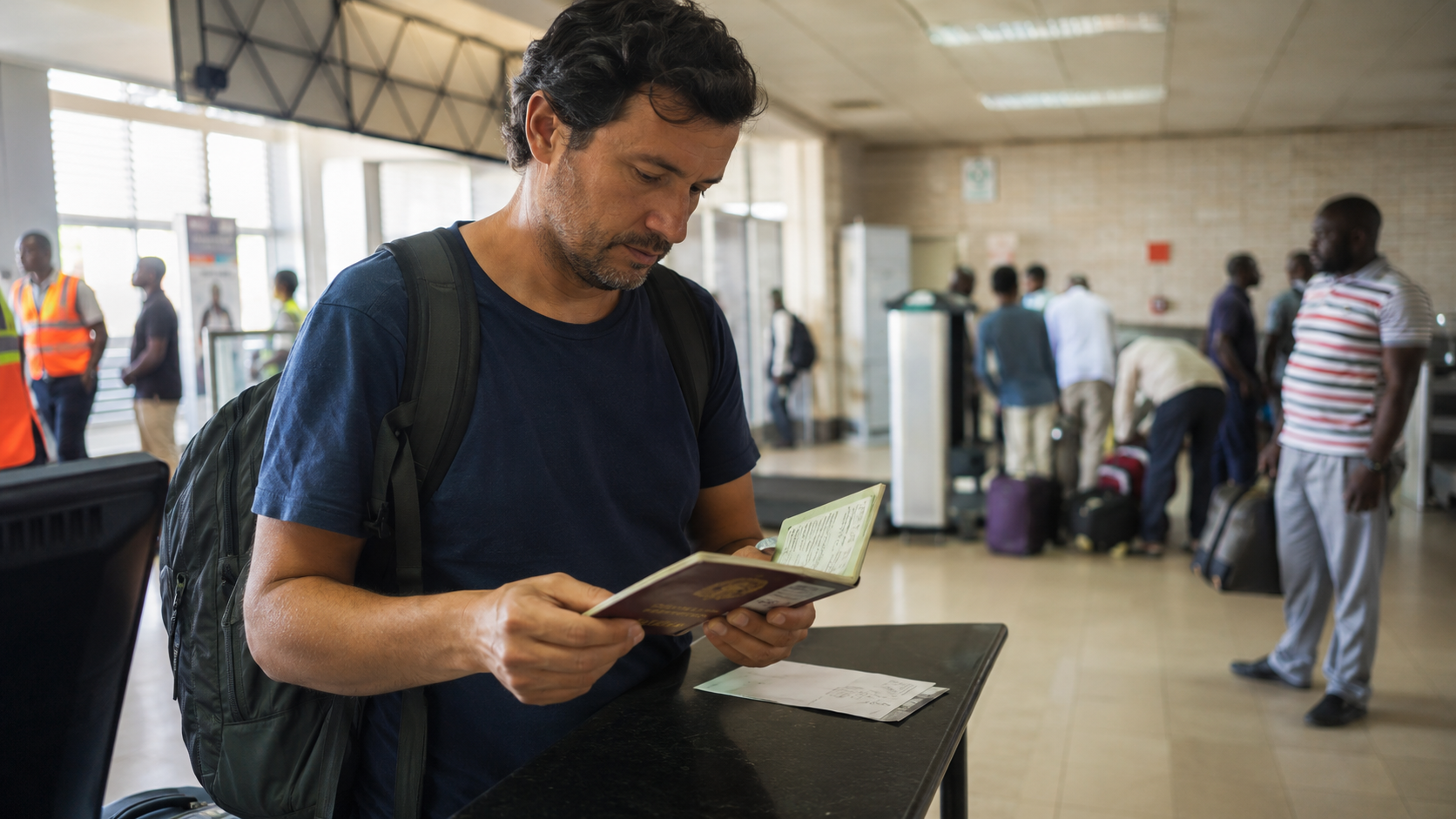
If you are planning a trip to Equatorial Guinea, it is worth reviewing your documents before booking flights or finalising business meetings. Most travel problems do not occur during the stay itself, but before boarding the plane or when passing through immigration controls.
Unlike many other destinations frequently visited by European travellers, Equatorial Guinea requires a little more preparation. A missing vaccination certificate, a passport that does not meet validity requirements, or accommodation details that cannot be located when requested may turn a straightforward process into an unnecessary complication.
If your destination is Malabo, arriving with all your paperwork organised from the beginning will allow you to focus on the purpose of your trip rather than dealing with administrative issues as soon as you land.
To travel to Equatorial Guinea, you will generally need a valid passport, an appropriate visa, and an International Certificate of Vaccination against Yellow Fever. It is also advisable to have confirmed accommodation and international medical insurance before travelling.
What Do I Need to Travel to Equatorial Guinea?
The question sounds simple, but there are several requirements that should be reviewed well in advance. While entry conditions may vary depending on nationality and the purpose of the trip, certain documents are commonly required for most travellers entering Equatorial Guinea.
| Requirement | Typical Status |
|---|---|
| Valid Passport | Mandatory |
| Visa | Mandatory |
| Yellow Fever Vaccination Certificate | Mandatory |
| Accommodation Reservation | Recommended |
| International Medical Insurance | Strongly Recommended |
| Return or Onward Ticket | May Be Requested |
Many travellers assume that the visa is the only important formality. In reality, issues often arise from much simpler matters. A missing accommodation booking, incomplete paperwork, or discovering at the last minute that a certificate cannot be found can create more complications than the visa process itself.
A practical recommendation: keep digital copies of your documents, but carry printed versions as well. It may seem unnecessary until the moment you need to present a document and discover that your phone battery is dead or your internet connection is unreliable.
If this is your first visit to the country, you may also find useful this guide about travelling to Equatorial Guinea for the first time, which includes additional recommendations to help you prepare your trip.
Do I Need a Visa to Travel to Equatorial Guinea?
Yes. Spanish citizens and many other foreign nationals generally require a valid visa to enter Equatorial Guinea.
This is where many questions usually begin. Not every trip has the same purpose, and for that reason not every visa application follows exactly the same process. A tourist visit, a business trip, or a longer professional stay may involve different requirements.
It is worth defining the real purpose of your trip from the outset. That may sound obvious, but attempting to fit a business-related journey into a visa category intended for another purpose often creates unnecessary complications.
Most Common Types of Visa
The most common categories generally include:
Tourist visa
Business visa
Family visit visa
Visas linked to specific professional activities
During the application process, travellers are often asked to provide information regarding their accommodation, the duration of their stay, and the activities they plan to undertake while in the country.
If your trip involves fixed meeting dates, conferences, corporate events, or contractual obligations, leaving visa arrangements until the last minute is rarely advisable.
Passport and Required Documentation
Before thinking about hotels, flights, or business schedules, check your passport.
It sounds like basic advice, yet every year travellers discover too late that their passport is close to expiry or does not meet the validity requirements needed for international travel.
Beyond the passport itself, it is worth organising all travel documents in a dedicated folder. When information is scattered across email inboxes, screenshots, and multiple applications, even simple procedures can become unnecessarily time-consuming.
Documents Worth Carrying in Printed Form
Although we live in an increasingly digital world, carrying printed copies of key documents remains a sensible precaution.
These documents typically include:
Accommodation booking confirmation
Flight tickets
Medical insurance policy
Vaccination certificate
Visa confirmations
Professional or business documentation when relevant
There is another detail many travellers overlook: consistency. Hotel bookings, flight dates, and the declared duration of stay should all match. When the documents tell the same story, verification procedures tend to be much smoother.
Vaccinations Required for Travel to Equatorial Guinea
Health requirements generate almost as many questions as visa regulations.
For first-time visitors, vaccinations are often one of the first concerns. Some are simply recommended, while others form part of the documentation that may be requested upon arrival.
Yellow Fever Vaccination
The Yellow Fever vaccine is generally one of the most important health requirements for travel to Equatorial Guinea.
Receiving the vaccine is not enough on its own. What authorities usually request is the International Certificate of Vaccination that proves it has been administered.
A surprisingly common situation involves travellers who received the vaccine years ago but cannot locate the certificate when preparing for their trip. Solving that problem a few days before departure can become a stressful and completely avoidable challenge.
For that reason, it is wise to verify that the certificate is available well before travelling.
Other Health Recommendations
Not every traveller faces the same circumstances.
A short business trip to Malabo presents different considerations from a longer stay or a journey involving travel through multiple regions of the country.
Because of this, consulting an international vaccination centre or a travel medicine specialist before departure is usually a sensible step. Personalised medical advice will always be more useful than generic recommendations found online.
Is Medical Insurance Mandatory?
Mandatory and advisable are not always the same thing.
Although requirements may vary depending on individual circumstances, travelling without international medical insurance means accepting risks that rarely justify the potential savings.
When everything goes smoothly, most people barely think about their insurance policy. When something goes wrong, it often becomes the most valuable document they carry.
For that reason, many experienced international travellers treat medical insurance as a standard part of travel preparation, just like a passport or visa.
Before purchasing a policy, it is worth reviewing the actual coverage included, particularly if the trip involves professional activities or an extended stay in Equatorial Guinea.
