

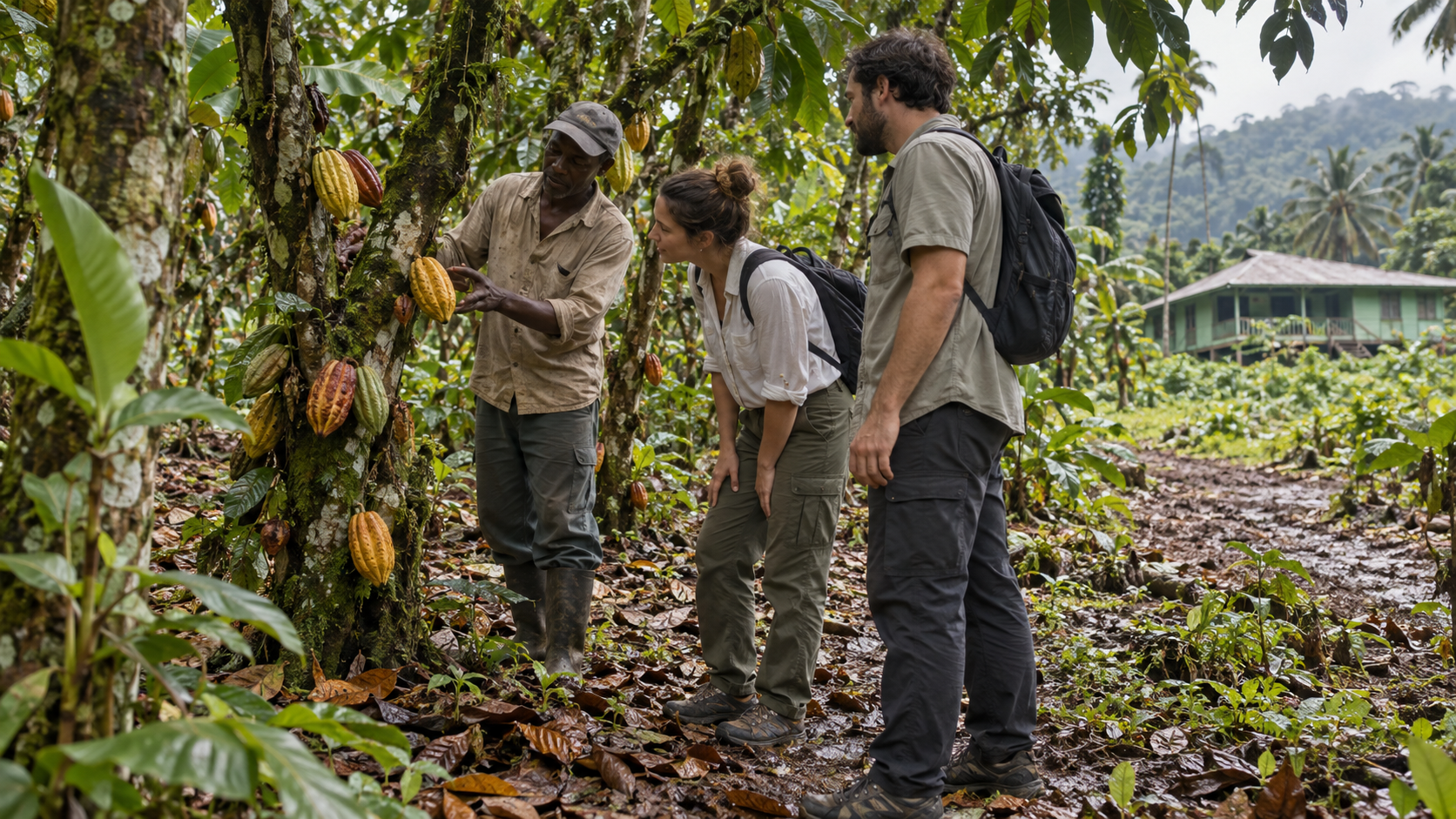
Visiting a cocoa plantation in Bioko is a fascinating way to explore a part of Equatorial Guinea's history that remains visible in the island's agricultural landscape. Just a few kilometres from Malabo lies Finca Sampaka, a century-old estate where cocoa cultivation and artisanal chocolate production continue a tradition closely connected to Bioko's past.
For anyone who has only encountered cocoa in the form of chocolate, walking through a plantation offers a very different perspective. The fruit grows directly from the trunks and main branches of the trees, and its seeds must undergo several stages of processing before becoming the chocolate we recognise. Then there is the history of the estates themselves, their buildings and the people who worked on them.
Finca Sampaka has a documented history of welcoming visitors, although there is something worth clarifying before planning an excursion. A working agricultural estate does not necessarily operate like a museum with fixed opening hours. Access arrangements and available activities should be confirmed in advance.
Can You Visit a Cocoa Plantation in Bioko?
Yes. Finca Sampaka is one of the cocoa estates on Bioko Island with documented organised visitor experiences. It is located at kilometre 7 on the road towards Luba, near Malabo, and remains involved in cocoa cultivation and processing.
Organised visits offer an opportunity to explore the plantation, observe cocoa trees and learn how chocolate is produced from cocoa beans. Some programmes also include explanations of the production process, chocolate tastings and transport from your accommodation.
What matters is understanding exactly what each visit includes. An excursion booked through a tour operator may follow a fixed itinerary with specific services and timings. If you prefer to contact the estate directly, you will need to ask what arrangements are possible on your chosen date.
It would also be a mistake to assume that all of Bioko's historic cocoa plantations are open to tourists. Some remain exclusively agricultural operations, while others have historical interest but do not necessarily offer guided tours.
Finca Sampaka is a particularly useful starting point because the estate publishes information about its activities, and tour operators have offered organised experiences there.
Finca Sampaka: Cocoa, Chocolate and Bioko's History
According to CAMASA, the company currently associated with the estate, Finca Sampaka dates back to approximately 1906. Its history is closely connected to the development of cocoa cultivation on Bioko, an agricultural activity that once played a considerable role in the island's economy.
One of the estate's most recognisable features is an old green wooden house, reflecting the architecture associated with agricultural plantations of that period. It is a surviving reminder of a past that remains part of Bioko's landscape.
The estate continues to be associated with agricultural production and the manufacture of artisanal chocolate from cocoa.
What Can You See During a Visit?
The experience begins with the cocoa trees themselves. Their fruit, known as cocoa pods, grows directly from the trunk and main branches. Inside are the seeds used to make chocolate.
Documented visitor experiences include explanations of cocoa cultivation and the different stages of production. Some tours also cover areas where cocoa is processed.
There is one detail worth bearing in mind. A guided tour may explain the entire production process without every stage necessarily taking place during your visit. Harvesting and certain agricultural tasks depend on the growing cycle, while other activities may be arranged separately.
If you are particularly interested in observing a specific stage, such as fermentation, drying or chocolate making, ask whether it will be possible to see it on your chosen date.
From Cocoa Tree to Artisanal Chocolate
Chocolate production begins with harvesting ripe cocoa pods. Once opened, the seeds are removed together with the pulp surrounding them.
Fermentation follows, an essential stage in the development of compounds that influence cocoa's eventual aroma and flavour. After drying, the beans undergo further processing, including roasting and grinding, before becoming the ingredients used to make chocolate.
Finca Sampaka follows the tree-to-bar concept, connecting cocoa cultivation with chocolate production at its place of origin.
Some organised visits include tastings and opportunities to purchase products from the estate. If trying chocolate made in Bioko is one of your main interests, check that a tasting is included in the experience you choose.
How to Organise a Visit to Finca Sampaka from Malabo
Given its location, Finca Sampaka can be considered as an excursion during a stay in Malabo. However, its proximity to the city should not lead you to assume that you can simply turn up.
First, establish whether visitors can be received on your preferred date. Once that is settled, you can arrange transport and work out how much time to allow for the activity.
Reservations, Prices and Duration
Finca Sampaka has an official contact page where visitors can enquire about arranging a tour. This is the appropriate channel for checking conditions directly with the estate.
Before booking, ask about the price per person, the duration, the language used during the tour and the activities included. If you are travelling with children or as part of a group, check whether any specific conditions apply.
Another option is to book through a tour operator. Rumbo Malabo, for example, has advertised an excursion lasting approximately two hours, including collection from your accommodation, an easy cycling route and a chocolate tasting. Those arrangements belong to that particular programme and should not be assumed to apply to every visit to Finca Sampaka.
| Information | Details for Planning Your Visit |
|---|---|
| Plantation | Finca Sampaka |
| Location | Km 7, road towards Luba, Malabo |
| Main activity | Cocoa cultivation and artisanal chocolate production |
| Guided visits | Documented organised visitor experiences |
| Reservations | Contact the estate or a tour operator |
| Duration | Depends on the programme. A two-hour excursion has been advertised |
| Price | Request the current rate for your chosen experience |
| Chocolate tasting | Included in some organised tours |
| Transport | Depends on the booking arrangements |
If your travel dates are tight, also ask whether the visit can be cancelled or rescheduled. The availability of a working agricultural estate may be affected by circumstances that do not necessarily apply to conventional tourist attractions.
Where Is Finca Sampaka and How Do You Get There?
The estate's published address is kilometre 7 on the road towards Luba, with Malabo as the reference point.
You can arrange transport in advance or book an excursion that includes collection from your accommodation. Either way, make sure you understand how the return journey will work.
A taxi booked solely for the outward journey may not be waiting when you finish. Similarly, do not assume that the two hours advertised by a tour operator necessarily include all transfers unless this is clearly stated.
If you need advice on local transport, our guide to getting around Malabo and Bioko explains how to plan journeys in and beyond the capital.
Before leaving, confirm three things: that the visit is available, what the tour includes and how you will return to Malabo. Once these details are settled, organising the excursion becomes much easier.
The Importance of Cocoa in Bioko's History
During the colonial period, cocoa played a significant role in Bioko's agricultural and commercial development. Plantations became an important part of the island's economy, leaving behind estates, buildings and other features that still recall that period.
There is also a social dimension to this history. Working arrangements on the plantations were shaped by the labour relations and inequalities of the colonial system. Discussing Bioko's cocoa heritage without acknowledging those conditions would leave out an essential part of its past.
Following Equatorial Guinea's independence, the agricultural sector underwent major changes. Cocoa production gradually lost the economic position it had occupied during earlier periods of the island's history.
Today, local artisanal chocolate production represents another chapter in that tradition. Rather than viewing cocoa solely as an agricultural raw material, visitors can also learn about finished products made from locally cultivated beans.
Finca Sampaka preserves elements associated with different stages of this history. Much of its interest lies in the connection between agriculture, production and historical heritage.
Practical Tips for Visiting a Cocoa Plantation
A cocoa plantation does not necessarily have the same conditions as an urban tourist attraction. Tours may follow agricultural paths, with wet or uneven ground, particularly after rainfall. This is especially relevant in Bioko's tropical climate.
Closed, comfortable footwear and lightweight clothing are sensible choices, along with protection against rain and insects. You should not expect every working area to be open to visitors. Some facilities may have restrictions for operational or safety reasons.
If you are travelling with young children or someone with reduced mobility, ask how much walking is involved and what the access routes are like. A general excursion description may not give you enough information to judge whether the tour is suitable.
Weather conditions deserve some attention too. If heavy rain is forecast, check whether the activity will go ahead and what alternatives are available if arrangements need to change.
During the visit, follow the instructions of the estate's staff. Cocoa trees, fruit and production facilities are part of a working agricultural operation, not an exhibition where everything can be handled freely.
If you have several days on the island, you can combine the experience with other excursions from Malabo around Bioko Island. Our guide to what to do in Malabo in three days can also help you spread activities across your stay.
Where to Stay in Malabo While Exploring Bioko
If you plan to visit Finca Sampaka and explore other parts of the island, staying in Malabo makes it easier to organise your journeys from the capital. It is also worth thinking about what happens after each outing. Having restaurants and places to relax at your accommodation means you do not have to arrange further journeys at the end of a day exploring.
Hotel Anda Malabo, located in Malabo II, offers different accommodation options for leisure travellers, business visitors and guests planning longer stays.
Hotel Anda II has Deluxe and Executive rooms, along with several categories of suites. Travellers seeking greater independence can consider Anda Residence, which offers apartments with equipped kitchens.
The complex also has restaurants and leisure and wellness facilities, including swimming pools, a gym, sauna and Turkish bath. According to the hotel's published general information, stays include a buffet breakfast and complimentary airport transfers, along with access to certain facilities, subject to the conditions of the accommodation booked.
Airport transfers should not be confused with transport to Finca Sampaka. Visiting the estate requires separate travel arrangements or an excursion package that includes transport.
For business travellers visiting Malabo, a cocoa plantation excursion may be an interesting cultural activity during a free morning or afternoon. In that case, it is worth checking the total duration before adding the visit to a professional schedule.
Planning a stay on Bioko Island? Hotel Anda Malabo offers rooms, suites and apartments for different travel needs, with dining, wellness and guest services available throughout your stay.
Frequently Asked Questions About Visiting Cocoa Plantations
Do You Need to Book in Advance to Visit Finca Sampaka?
Contacting the estate or a tour operator beforehand is recommended. Guided visits have been documented, but availability may vary. Finca Sampaka has official contact channels where you can request information before travelling to the estate.
How Much Does It Cost to Visit Finca Sampaka?
There is no confirmed, up-to-date general admission price that applies to every type of visit. Ask for the current price of your preferred experience and check whether it includes a guide, chocolate tasting, transport or other activities.
How Much Time Should You Allow for the Visit?
Rumbo Malabo has advertised an excursion lasting approximately two hours, although that duration applies to its own programme. For other arrangements, confirm the length of the tour and allow additional time for travelling to and from Malabo.
Can You Visit a Cocoa Plantation with Children?
A plantation visit can be an interesting educational experience, particularly for learning how cocoa is grown and chocolate is made. Before booking, check whether children are accepted and whether the paths and facilities are suitable for them.
Can You Visit Finca Sampaka During the Rainy Season?
This depends on the estate's availability, ground conditions and the weather on your chosen date. You should not assume that visits are suspended throughout the entire rainy season. The sensible approach is to confirm the activity before travelling.
